
Error Correction (.aerocorrect)
AeroVault format v4 (format v3 plus error correction) adds a fourth wrapper to the stack: error correction. It writes a detached, par2-style Reed-Solomon recovery sidecar, the .aerocorrect file, that can repair bit rot in any byte stream: a sealed .aerovault container, a synced backup file, or an ordinary standalone file. On cloud backends durability is already redundant; on USB sticks, consumer NAS disks, optical media, and cold-storage archives, a single bad sector is the difference between an encrypted backup surviving and being gone. Error correction closes that gap.
Credit
Error correction is the fourth wrapper in the design contributed by Ehud Kirsh in the AeroFTP COMMUNITY ROADMAP thread (issue #162) and refined in the Error Correction discussion (#276). The unified one-format-for-any-file .aerocorrect design, the placement model, and the overhead levels are his calls.
What .aerocorrect is
.aerocorrect is a detached Reed-Solomon parity sidecar for any byte stream. It protects the bytes of the target without embedding anything into it, so the same format repairs .aerovault containers, synced files, or ordinary files. The sidecar is content-addressed: it binds to the SHA-256 of the protected content, not to a path, vault salt, account, or provider identity. Move the file, rename it, copy it to another disk, and the same sidecar still verifies and repairs it.
The magic bytes are AEROCORR. The format is shared byte-for-byte between the AeroFTP application (v4) and the standalone aerovault crate (0.5.0), pinned by a cross-implementation fixture: a sidecar produced by one verifies and repairs with the other for the same file and overhead level.
Where it sits in the wrapper stack
Error correction is the last wrapper in the AeroVault pipeline. It runs after encryption, so it protects the ciphertext bytes and never has to decode the format. It adds parity alongside the data rather than transforming it, which is why v3 + error correction = v4: a v3-only reader simply skips the parity it does not understand and still opens the container.
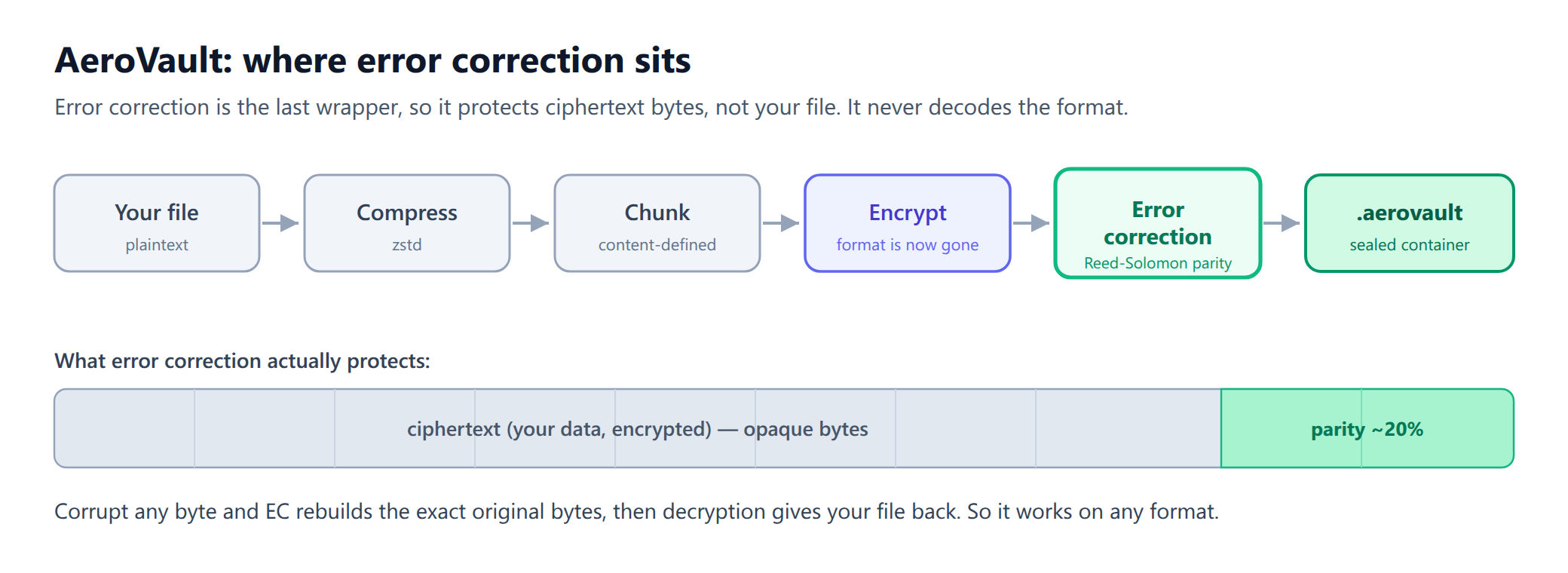
Because parity sits over the cipher blocks, redundancy is strictly for recovery, not for trust. Repair fixes damage before decryption; AES-256-GCM-SIV remains the sole authority on tampering. A repaired stream that an attacker forged still fails the authenticated decrypt.
The definitive stage sequence of the full wrapper stack is:
packing
  -> chunking (Gear-CDC, content-defined boundaries)
  -> keyed-BLAKE3 chunk id (dedup key)
  -> compression (zstd, per chunk)
  -> encryption (AES-256-GCM-SIV, per chunk)
  -> cipher hash (BLAKE3-256, pre-decryption integrity)
  -> error correction (Reed-Solomon parity over the cipher blocks)
Compression runs before encryption (ciphertext is incompressible) and after chunking (a single compression stream over the whole input would destroy content-defined chunk boundaries). See The AeroFTP Wrapper Stack for the full reasoning behind the ordering.
Placement: detached, embedded, or both
For a vault the parity can live in three places (RecoveryPlacement):
| Placement | Where parity lives | Effect on the container |
|---|---|---|
detached (default) | Sibling .aerocorrect file next to the container | Container stays byte-identical to a plain v3 vault |
embedded | A non-critical extension inside the container, recomputed on every seal | One self-contained file, parity travels with it |
both | Sidecar and in-container extension | Redundant recovery surfaces |
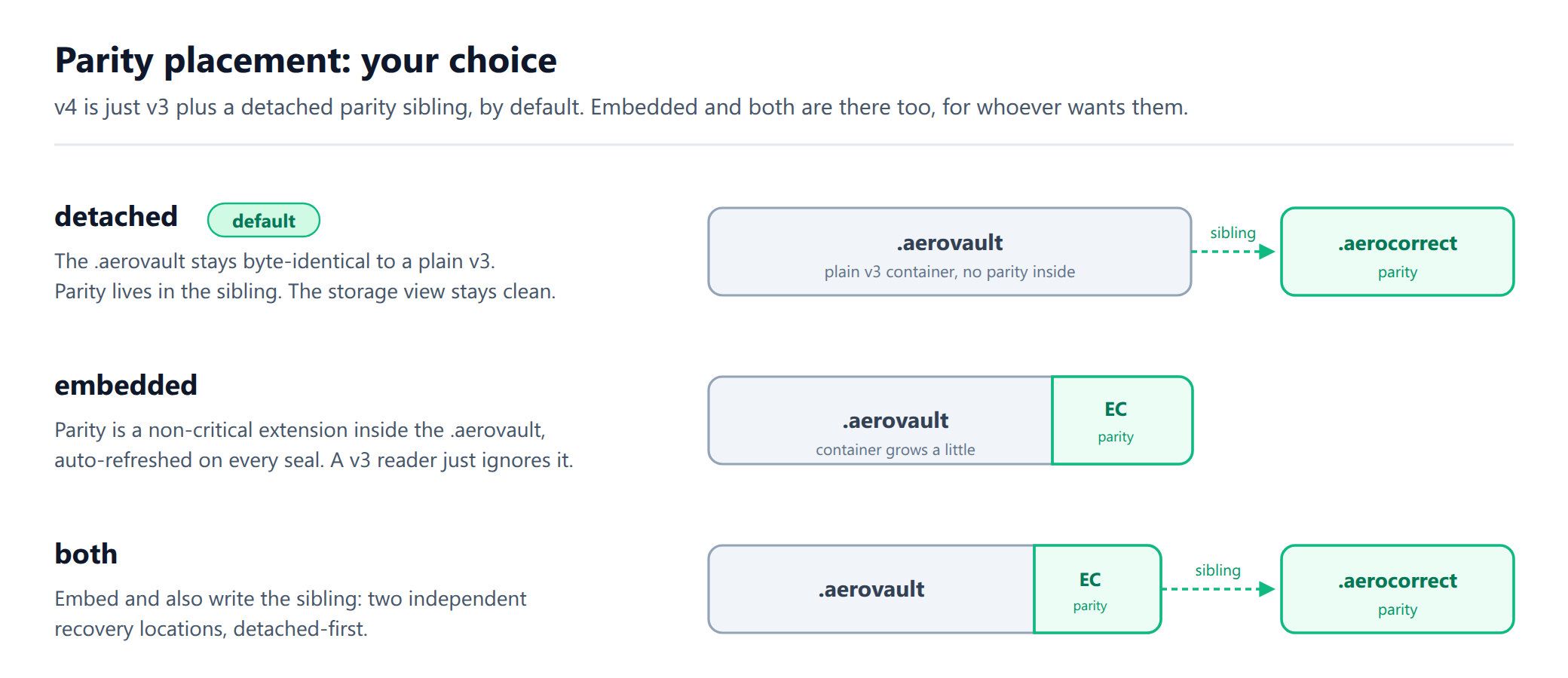
The default is the detached sidecar because it keeps the container byte-identical to a plain v3 vault and lets you add or refresh parity later without rewriting the encrypted data. For secret.aerovault the default sidecar path is secret.aerovault.aerocorrect.
A vault writes exactly three segments (windows) over its container file, in a fixed order, so each region's parity is found by position: a header window, a manifest (locator) window, and a data window. The header and manifest travel outside the container on purpose: a damaged header or manifest cannot self-locate its own recovery (a chicken-and-egg problem), so the sidecar lets the reader rebuild them and prove correctness by the header MAC and the manifest cipher.
For a standalone file or a synced backup there is no three-region structure: the sidecar simply tiles the whole stream into bounded windows and protects each one.
Self-healing (format v2)
The .aerocorrect v2 format is self-healing: a lightly-corrupted sidecar still recovers instead of being rejected wholesale.
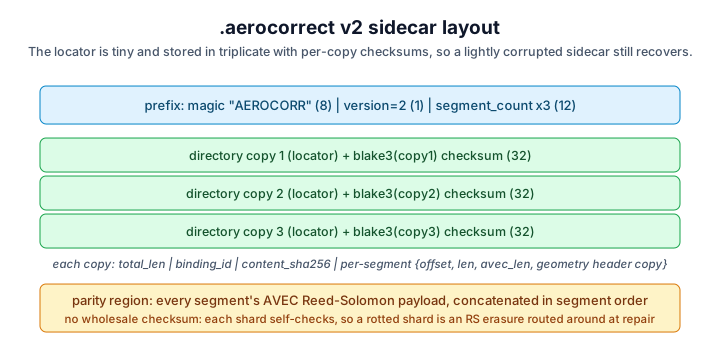
The split is deliberate:
- The tiny metadata that locates everything (the segment directory, the content hash, and the per-window geometry) is stored in triplicate with per-copy checksums. A single rotted directory copy is detected and the read falls back to a good copy; if no single copy verifies, the locator is reconstructed by byte-majority across the three copies and then validated against the content binding. A reconstruction that does not satisfy the binding is rejected.
- The bulk parity carries no wholesale checksum. Every Reed-Solomon shard (data and parity) already carries its own checksum, so a rotted parity shard is simply treated as an erasure and routed around at repair time.
This is the key correctness fix over the pre-v2 framing, which used a single all-or-nothing envelope checksum that rejected the entire sidecar on any flip. Self-healing costs about 360 fixed bytes regardless of file size: it does not eat into the main file's parity budget. v1 sidecars are still read; all new sidecars are written as v2.
Overhead levels
CLI levels map to storage-overhead targets. The exact Reed-Solomon grid is stored in each payload, so a reader reconstructs from the payload metadata rather than from a CLI-level assumption.
| Level | Target overhead | Reed-Solomon grid |
|---|---|---|
low | ~7% | approx K=14, P=1 |
medium | ~15% | approx K=13, P=2 |
quartile | ~25% | K=8, P=2 |
high | ~30% | approx K=7, P=2 |
| numeric | 5-50% | clamped into the supported range |
Higher overhead survives more damage at the cost of a larger sidecar. medium (~15%) is a sensible default for cold media; raise it for media you expect to degrade.
CLI
Standalone files: correct gen | verify | repair
The aeroftp-cli correct subcommand protects any file, vault or not:
# Generate a detached recovery sidecar (writes report.bin.aerocorrect)
$ aeroftp-cli correct gen report.bin --ec medium
Wrote report.bin.aerocorrect (31543 bytes, 1 segment(s), 15 shards, 15.5% overhead) for report.bin

# Verify without modifying the file
$ aeroftp-cli correct verify report.bin
Verified: report.bin matches report.bin.aerocorrect

# ...after a 4 KiB run in report.bin is overwritten with zeros...
$ aeroftp-cli correct verify report.bin
Corruption detected in report.bin: run `correct repair` to recover from report.bin.aerocorrect

# Repair in place from the sidecar
$ aeroftp-cli correct repair report.bin
Repaired report.bin from report.bin.aerocorrect (1 shard(s) reconstructed)
Vaults: scrub, repair, and parity management
A vault can be created with error correction enabled, scrubbed (verified) on demand, and repaired from whichever parity source is available:
# Create an Error Correction vault at a chosen overhead level
aeroftp-cli vault create secret.aerovault --error-correction --recovery-level medium

# Verify the container against its parity (embedded or sidecar)
aeroftp-cli vault scrub secret.aerovault

# Repair damaged regions; --dry-run reports without writing
aeroftp-cli vault repair secret.aerovault
aeroftp-cli vault repair secret.aerovault --dry-run

# Write or refresh a detached sidecar for an existing vault, without rewriting the container
aeroftp-cli vault export-parity secret.aerovault

# Drop the embedded parity copy (refuses unless a sidecar exists, or --force)
aeroftp-cli vault strip-parity secret.aerovault
export-parity is the add-later win: it reads the encrypted container and writes a sidecar without rewriting the vault, so you can enable recovery on a container that was sealed without it. strip-parity refuses to leave a vault with no recovery at all unless you pass --force. For scrub and repair the parity source resolves in order: an explicit --parity path, then the <vault>.aerocorrect sidecar, then the embedded extension; the chosen source is reported.
Sync: sync --error-correction
AeroSync shares the same .aerocorrect sidecar and overhead levels. Enable it on a sync job so each transferred file gets a sidecar:
# Generate sidecars alongside the synced files
aeroftp-cli sync ./local remote:backup --error-correction

# Cap the parity overhead a small file is allowed to add (skips parity below the benefit threshold)
aeroftp-cli sync ./local remote:backup --error-correction --ec-max-overhead 25
A bit-rotted remote backup is then repaired on the next pull from its sidecar, without needing the original.
Security and repair model
Repair is fail-closed and all-or-nothing.
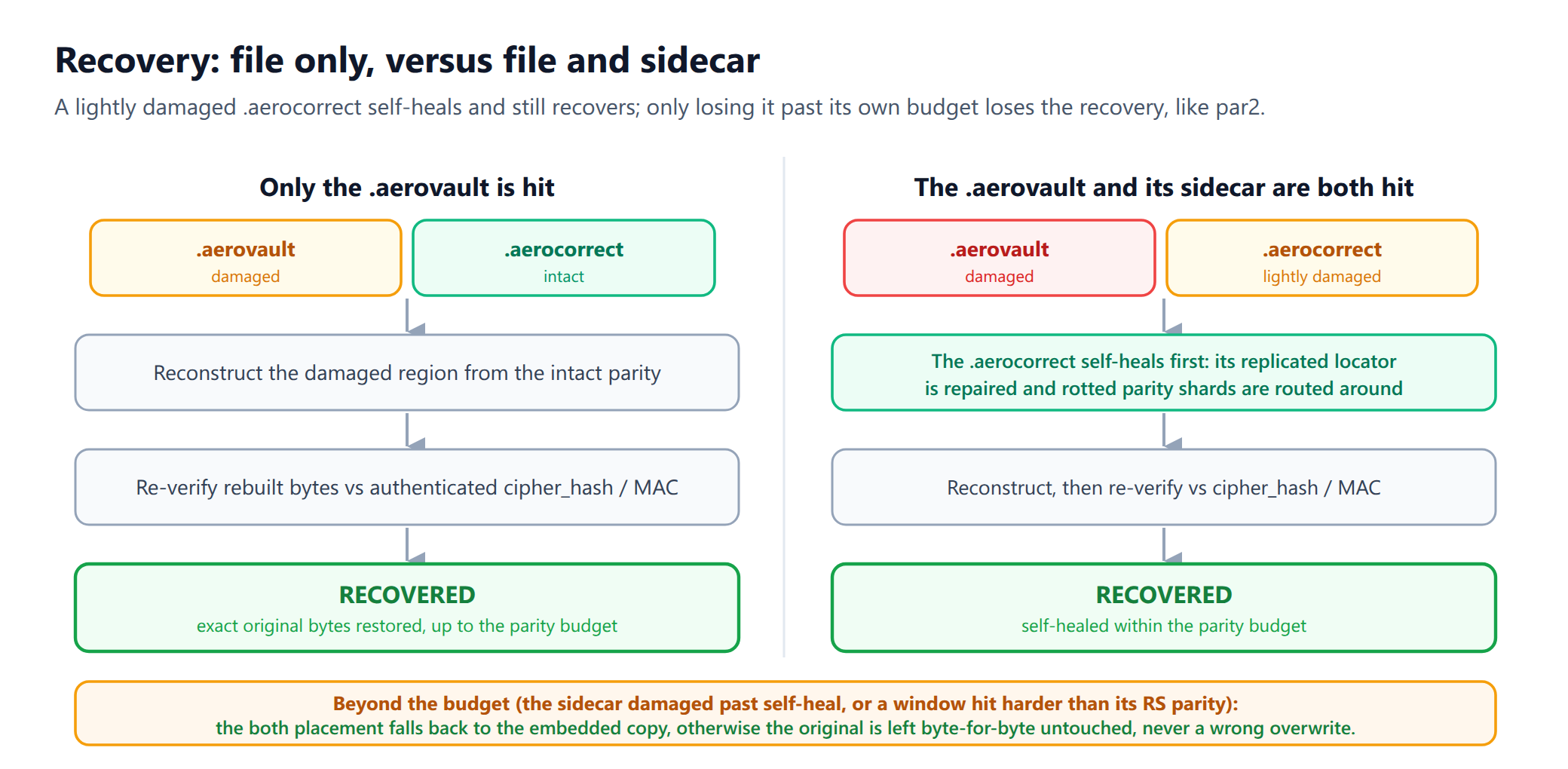
- Re-verify before replace. The rebuilt stream is re-verified against the bound content hash before the original is replaced. For a vault, every reconstructed region is additionally re-verified against the container's authenticated values (the header MAC and the manifest
cipher_hash) before being persisted. - A foreign or corrupt sidecar can only make a repair fail, never overwrite good data. Because the gate is the authenticated re-verify, a stale or attacker-supplied sidecar cannot push bad bytes into a healthy file.
- Atomic writes. Repair writes to a temporary file and renames it into place, so a crash mid-repair never leaves a half-written original.
- All-or-nothing for vaults. A vault is re-sealed only if every repaired block re-verifies; otherwise the file is left byte-for-byte untouched.
Bounded memory
Generation and repair run in 64 MiB windows and read sidecar parity on demand, so memory is bounded to one window plus that window's parity payload, regardless of file size. The .aerocorrect file is capped at 1 GiB.
Specifications
AEROCORRECT-SPEC.mdis the full v2 binary layout for the detached sidecar.AEROVAULT-V3-SPEC.mdsection 11 covers the vault-side placement and thev3 + error correction = v4evolution.- The AeroFTP Wrapper Stack is the intuition for why error correction is the fourth wrapper and where it sits in the pipeline.